Topic 2.6: Eclipses
For most of history, an eclipse was terrifying. In the middle of the day, the Sun grew dark. Today we know exactly why it happens, and can predict eclipses centuries ahead. They are still among the most amazing things you can see.

Two Kinds of Eclipse
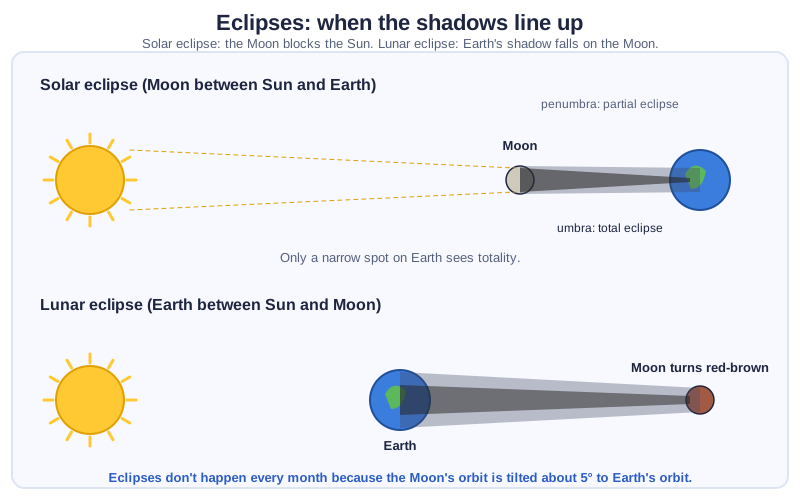
- Solar eclipse: the Moon passes between the Sun and Earth, and its shadow falls on part of Earth. This can only happen at new Moon.
- Lunar eclipse: Earth passes between the Sun and Moon, and Earth's shadow falls on the Moon. This can only happen at full Moon.
Types of solar eclipse
| Type | What you see |
|---|---|
| Total | The Moon completely covers the Sun for a few minutes. The sky darkens, the corona (the Sun's outer atmosphere) appears, stars come out |
| Partial | The Moon covers only part of the Sun |
| Annular | The Moon is a little too far away to cover the Sun fully, leaving a bright "ring of fire" |
A total eclipse is only possible because of a remarkable coincidence: the Sun is about 400 times wider than the Moon, and about 400 times farther away. So they look about the same size in the sky (about half a degree).
The Moon's shadow has two parts: the dark central umbra (where a total eclipse is seen) and the lighter penumbra (where it is partial). The umbra is at most about 270 km wide where it touches the ground, so totality is seen only along a narrow path.
Lunar eclipses
During a total lunar eclipse, the Moon slides into Earth's shadow and turns a dim coppery red. The red is sunlight bent and filtered through Earth's atmosphere, as though all of Earth's sunrises and sunsets were shining onto the Moon. Totality can last up to about 1 hour 45 minutes, and it is safe to watch with your eyes.
Why Aren't There Eclipses Every Month?
The Moon's orbit is tilted about 5 degrees to Earth's orbit. Most months, the Moon passes above or below the Sun-Earth line and the shadows miss. Eclipses happen only when a new or full Moon occurs near the two points where the orbits cross (the nodes).
Watching Safely
- Never look at the Sun with the naked eye, or with a camera, binoculars or telescope, except during the few minutes of totality. Even a partly eclipsed Sun can burn the retina, and you will not feel it.
- Use eclipse glasses marked ISO 12312-2. Regular sunglasses are not safe.
- You can make a pinhole viewer from a card. The tiny gaps between tree leaves also make crescent-shaped spots of light on the ground.
- Lunar eclipses are safe to look at.
On August 21, 2017, a total solar eclipse crossed the United States from Oregon to South Carolina. Most of Alabama saw a deep partial eclipse, with roughly 85 to 98 percent of the Sun covered. The next total solar eclipse that crosses the lower 48 states will be on August 12, 2045.
Worth a Pause
Jesus was crucified under a darkness that came over the land (Luke 23:44-45), and the prophets spoke of the Sun turning to darkness as a sign (Joel 2:31). We will not claim to explain the one with the other. What we can say is that the heavens obey rules, and that rules can be seen even in a wonder: the same sky that can frighten us will keep its appointment tomorrow. When a total eclipse is over, people often cheer, and some quietly cry. That is a natural reaction to something so large and so exact.

Try It: Moon Phase Match. Match each spot in the Moon's orbit to the phase you would see from Earth, then call the tides. Play Moon Phase Match »
Practice Problems
- During which Moon phase can a solar eclipse happen? A lunar eclipse?
- What is the difference between the umbra and the penumbra?
- Why is a total solar eclipse possible? (Give the size-and-distance coincidence.)
- Why do solar and lunar eclipses not happen every month?
- Why does the Moon turn red during a total lunar eclipse?
- Name two safe ways to view a solar eclipse and one unsafe way.
- What is an annular eclipse?