Topic 3.9: Telescopes Today
A telescope is mostly a light bucket. Its main job is not to make things bigger but to collect more light than your eye can, so that faint things become bright.

Two Kinds of Optical Telescopes
- Refractors use a lens at the front to bend (refract) light to a focus. Galileo's telescope was a refractor. The largest ever used for research is the 40-inch refractor at Yerkes Observatory in Wisconsin (1897). Glass lenses sag if they get any bigger.
- Reflectors use a curved mirror to collect light. Newton built the first one. Mirrors can be supported from behind, so they can be much larger. Nearly all large modern telescopes are reflectors.

Bigger is better, but not for magnification
A telescope's power comes from its aperture, the diameter of its main lens or mirror. Light gathered goes by the area, so it grows as the square of the diameter. A 200 mm (8-inch) backyard telescope collects about (200 / 7) squared = 800 times as much light as your eye, whose pupil is about 7 mm wide at night. Magnification matters less: if the image is dim and blurry, making it bigger does not help.
Beyond Visible Light
Stars, galaxies and gas also give off radio waves, infrared, ultraviolet, X-rays and gamma rays. Each needs its own kind of telescope, and many wavelengths are blocked by Earth's air.
- Radio telescopes use big dishes. The Green Bank Telescope in West Virginia is 100 meters wide. The Very Large Array in New Mexico combines 27 dishes.
- Space telescopes fly above the air.
Telescopes in Space
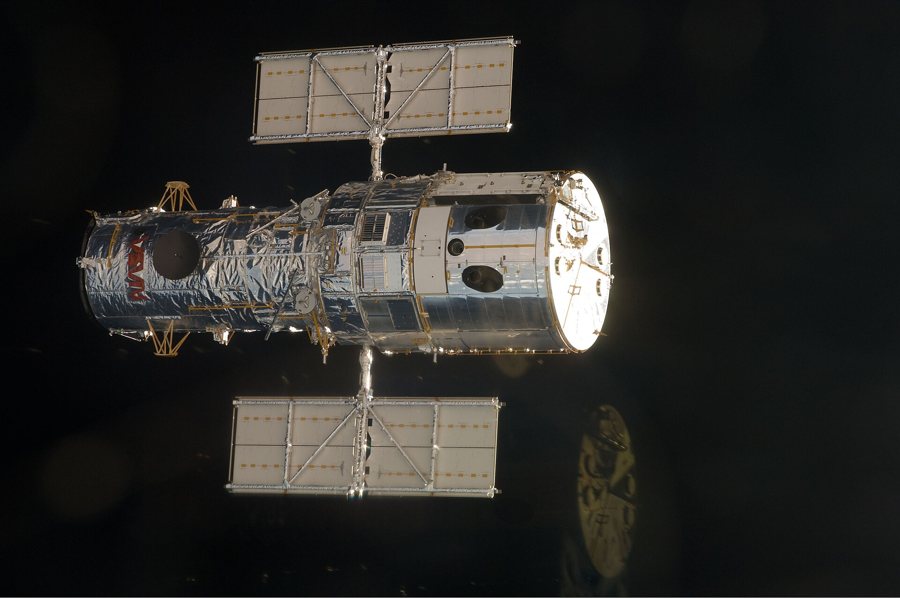
- The Hubble Space Telescope (launched 1990) orbits about 540 km up, with a 2.4-meter mirror. Its first images were blurry because of a mirror flaw, fixed by astronauts in 1993. It has made over 1.5 million observations. NASA's Marshall Space Flight Center in Huntsville, Alabama, helped develop it.
- The James Webb Space Telescope (launched December 25, 2021) has a 6.5-meter gold-coated mirror, made of 18 hexagons, and sees in infrared. It sits about 1.5 million km from Earth, on the side away from the Sun, with a sunshield the size of a tennis court to keep it very cold.
- Chandra (X-rays) is managed by the Marshall Center in Huntsville.

Why Put Telescopes on Mountains?
Earth's air makes stars twinkle and blurs images (astronomers call this "seeing"). The best ground-based telescopes are on dry, high mountains, such as Mauna Kea in Hawaii and the Atacama Desert in Chile, and many use adaptive optics: a mirror that flexes hundreds of times a second to cancel the blur.
Your First Telescope
A good first instrument is a pair of binoculars (7x50 or 10x50). They show Jupiter's moons, craters on the Moon, and star clusters, and cost far less than a telescope. After that, a Dobsonian reflector is the best value per inch of aperture.
Worth a Pause
The Hubble and Webb telescopes show galaxies that no eye ever saw. It's tempting to think seeing "more" must mean understanding more. David wrote, long before any telescope, "When I consider thy heavens, the work of thy fingers, the moon and the stars, which thou hast ordained; what is man, that thou art mindful of him?" (Psalm 8:3-4). Better instruments make that question larger, not smaller.
Try It: Name That Astronomer. Read the clues and name the astronomer, from the ancient Greeks to modern times. Play Name That Astronomer »
Practice Problems
- What is the difference between a refractor and a reflector?
- Why are large telescopes reflectors?
- A telescope has an aperture of 100 mm and your pupil is 5 mm at night. How many times more light does the telescope gather?
- Why do astronomers send telescopes into space?
- What kind of light does the James Webb Space Telescope see?
- What is adaptive optics?
- What is a good first instrument for a beginner?