Topic 4.10: Kepler's Laws in Numbers
In Topic 3.4 we met Kepler's three laws. Here we use them.
Law 1: Ellipses and Eccentricity
An orbit is an ellipse. How stretched it is, is its eccentricity (e). A circle has e = 0, and the higher e is, the longer the oval. A real ellipse also has a perihelion (closest to the Sun) and an aphelion (farthest).
- Perihelion distance = a x (1 - e)
- Aphelion distance = a x (1 + e)
(Here a is the average distance, called the semi-major axis.)
| Object | e |
|---|---|
| Venus | 0.007 |
| Earth | 0.017 |
| Mars | 0.093 |
| Mercury | 0.206 |
| Halley's comet | 0.967 |
Most planets are nearly circular, which is why the old astronomers' circles were so close. Earth is 147.1 million km from the Sun at perihelion (early January) and 152.1 million at aphelion (early July).
Draw an ellipse
Push two thumbtacks into a board, tie a loop of string around them, and pull it tight with a pencil. Move the pencil, keeping the string tight, and it draws an ellipse. The thumbtacks are the foci. Move the tacks closer together and the ellipse gets rounder; farther apart and it gets longer.
Law 2: Equal Areas
A planet moves faster when it is close to the Sun. The speed ratio is almost exactly the inverse of the distance ratio:
Speed at perihelion / speed at aphelion = aphelion distance / perihelion distance
- Earth: 1.017 / 0.983 = 1.03. Earth moves 3% faster in January than in July.
- Halley's comet: it is 0.59 AU from the Sun at perihelion and 35 AU at aphelion, a ratio of about 60. At its fastest it is moving about 55 km/s; at its slowest only about 1 km/s.
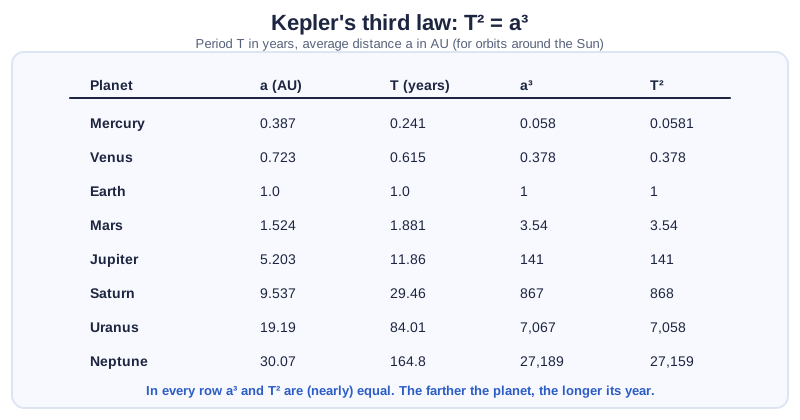
Law 3: T squared = a cubed
For anything orbiting the Sun, with the period T in Earth years and the average distance a in AU:
T squared = a cubed
| Planet | a (AU) | a cubed | T = square root (years) | Actual |
|---|---|---|---|---|
| Mercury | 0.387 | 0.058 | 0.241 | 0.241 |
| Venus | 0.723 | 0.378 | 0.615 | 0.615 |
| Earth | 1.000 | 1.000 | 1.00 | 1.00 |
| Mars | 1.524 | 3.54 | 1.88 | 1.88 |
| Jupiter | 5.203 | 140.9 | 11.87 | 11.86 |
| Saturn | 9.537 | 867 | 29.45 | 29.46 |
| Uranus | 19.19 | 7,067 | 84.1 | 84.0 |
| Neptune | 30.07 | 27,190 | 164.9 | 164.8 |
Worked examples
Find the year of a planet at 4 AU. a cubed = 64. T = square root of 64 = 8 years.
Find how far away Pluto is, given its year of 248 Earth years. T squared = 61,504, so a = the cube root of 61,504 = 39.5 AU.
Halley's comet has an average distance of 17.8 AU. a cubed = 5,640, so T = 75 years.
Beyond the Sun
Newton showed that the same law works for any object orbiting another, but the constant depends on the central mass. For moons circling Jupiter, you would use a different constant, and from the orbit of any moon, astronomers can weigh the planet. That is how we know the mass of Jupiter, Saturn and Neptune: by timing their moons. It also works for the orbits of stars around a black hole at the center of the Milky Way.
Worth a Pause
Kepler spent years chasing a mismatch of 8 arcminutes, and the laws that came out of it fit on a single page. Sometimes the work of a lifetime ends in three sentences. Proverbs says, "It is the glory of God to conceal a thing: but the honour of kings is to search out a matter" (Proverbs 25:2). There's a good deal of room, in that verse, for a student with a calculator and a lot of patience.

Try It: Orbit Lab. Launch a satellite, tune its speed, and see whether it falls, orbits or escapes. Play Orbit Lab »
Practice Problems
- Find the orbital period of an asteroid at 4 AU (square root of 64).
- Ceres has an orbit of average distance 2.77 AU. Use T squared = a cubed to find its year (a cubed is about 21.3).
- A comet has a period of 64 years. What is its average distance from the Sun? (64 squared = 4,096; the cube root of 4,096 is 16.)
- Mars has a = 1.52 AU and e = 0.093. Find its perihelion and aphelion distances.
- In which part of its orbit does a planet move fastest, and why?
- Earth's perihelion is 0.983 AU and its aphelion is 1.017 AU. By about what percentage is Earth faster in January than in July?
- How can an astronomer find the mass of Jupiter from one of its moons?