Topic 5.11: Stellar Alchemy: Where the Elements Come From
Hold a pen, a coin, a glass of water. Everything on Earth is made of elements: hydrogen, carbon, oxygen, iron, gold and about 90 others that occur naturally. Where did they come from? Astronomers have been able to answer this question in some detail, using spectra, nuclear physics, and what we can see exploding in the sky.
Hydrogen and Helium
In the standard (Big Bang) model, hydrogen and most of the helium were made at the very beginning of the universe (Topic 7.4). The universe today is still about 74% hydrogen and 24% helium by mass. All the other elements together are only about 2%. Astronomers call them all "metals."
Elements Made in Stars
| Where | What it makes | How |
|---|---|---|
| Sun-like stars (main sequence) | helium | fusing hydrogen |
| Red giants | carbon, oxygen, nitrogen | helium fusion (triple-alpha); some heavier atoms by slow neutron capture |
| Massive stars | oxygen, neon, magnesium, silicon, sulfur, calcium, up to iron | successive fusion in the "onion" layers of the core |
| Supernovae | many heavy elements, thrown out into space | the explosion itself |
| Neutron-star collisions | gold, platinum, uranium and other very heavy elements | rapid neutron capture (the r-process) |
Why iron? Iron nuclei are the most tightly bound of all. Fusing lighter nuclei up to iron releases energy; fusing iron or heavier takes in energy. So fusion in a star stops at iron, and everything heavier has to be made another way.
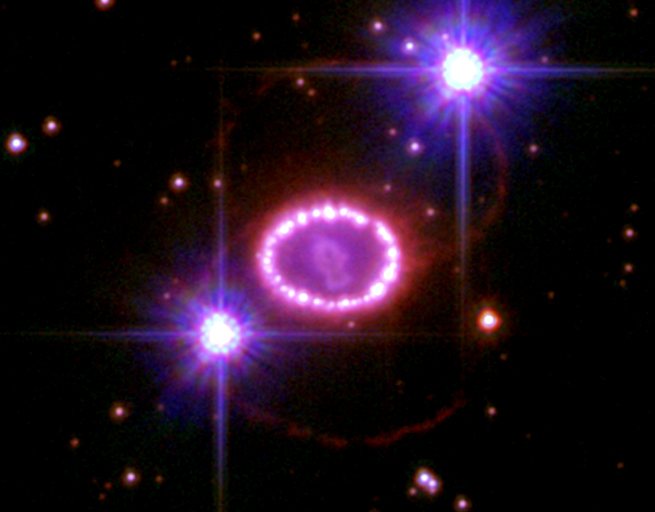
Proof from the sky:
- The spectra of supernova remnants such as the Crab show lines of oxygen, sulfur, iron and more.
- In August 2017, LIGO and telescopes around the world watched two neutron stars merge, 130 million light-years away. The light that followed matched what astronomers expected from freshly made gold, platinum and similar elements.
- The oldest stars (low in "metals") have almost no heavy elements; younger stars like the Sun have more, as one would expect if stars gradually enrich the gas around them.
What the Standard Model Says About Us
Astronomers like to say "we are made of star stuff": by their model, the carbon in your cells, the calcium in your bones, the iron in your blood were all fused in stars and scattered by explosions before the Sun formed. Carl Sagan made the phrase famous.
A Fair Look
This lesson has covered what is measured (the elements in stars and supernova remnants; the physics of fusion; the 2017 merger) and what is modeled (the history of how those elements built up over billions of years). Those are not the same kind of claim. Christians read the evidence differently:
- Some accept the standard model fully and see the stars as God's furnaces for the elements, as He prepared the "dust of the ground" (Genesis 2:7) from the stuff of the heavens.
- Some, including creation scientists, hold that God made the elements, the stars and the universe in the beginning, mature and complete, within a much shorter span.
- All agree that we did not make ourselves, that the universe is orderly and knowable, and that careful science is worth doing.
We include the standard model because you will meet it in textbooks, tests, and on the television, and because it is built on a lot of real observation.
(A note on timelines: the lifetimes and ages in this lesson come from the standard model of how stars work, which is tested by physics we can measure today. Many Christians who study science accept those ages; others, including creation scientists, hold to a much younger universe. How a star shines, how bright it is and how hot it is do not depend on that debate. We give the numbers because they appear in textbooks and tests, and so you can recognize them when you meet them.)
Worth a Pause
"For he knoweth our frame; he remembereth that we are dust" (Psalm 103:14). The Bible calls us dust, and astronomy has, in its own way, filled that word with meaning: ordinary elements, shared with the Sun and the stars. Whether you read the story of those elements in billions of years or in days, you end up in the same place: humble before a Creator who knows exactly what we are made of, and who loves us anyway. The standard model says the elements were forged in stars over billions of years. It is a theory built on real measurements, and a good one to know. Where this lesson stops is where the real question starts: what about creation? Someone made a universe in which stars could make carbon and iron, and a planet where we could breathe it. Ask who.
Try It: Star Life Cycle. Put a star's life stages in order, decide what a star of a given mass leaves behind, and trace where elements were made. Play Star Life Cycle »
Practice Problems
- What are the two most common elements in the universe, and about what percentage of the mass is each?
- Where does the standard model say the carbon and oxygen in your body came from?
- Why does fusion in a star stop at iron?
- How do astronomers think very heavy elements like gold are made?
- Give one piece of observational evidence for elements being made in stars.
- What is the difference between what has been measured and what is modeled in this lesson?
- Name one thing all Christians in the discussion agree on.