Topic 5.5: Fusion: How Stars Shine
Until about 100 years ago nobody knew why the Sun shines. Burning coal would have lasted only a few thousand years. Gravity squeezing the Sun would have lasted tens of millions of years. Neither fit the rocks. The answer came from nuclear physics: the Sun is a fusion reactor.

What Is Fusion?
Fusion means joining small atomic nuclei into a larger one. The nucleus of ordinary hydrogen is a single proton. Protons repel each other (both are positive), so pushing them together takes a lot of energy. But in the Sun's core:
- the temperature is about 15 million kelvins,
- the pressure is about 250 billion times the air pressure at the Earth's surface,
- and the density is about 150 times the density of water.
The protons move so fast, and are packed so tightly, that now and then two come close enough for the strong nuclear force to grab them. (Even then, it works only because of a quirk of the quantum world called tunneling: without it the Sun's core is not quite hot enough.)
The Proton-Proton Chain
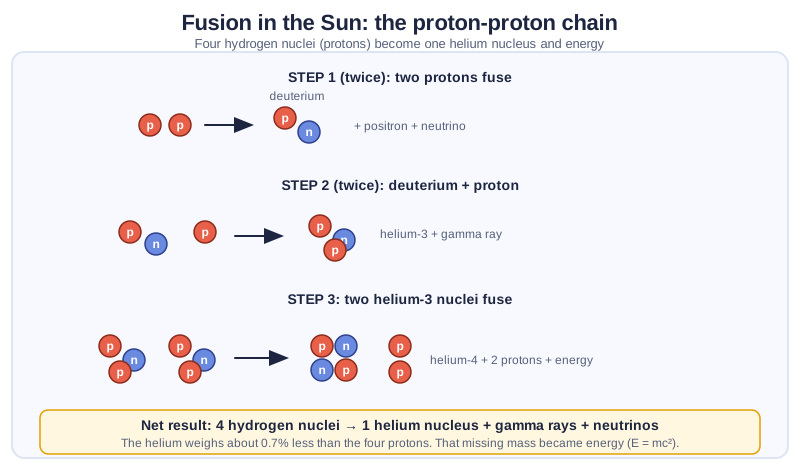
- Two protons fuse; one becomes a neutron and gives off a positron and a neutrino. The result is deuterium (a proton and a neutron).
- Deuterium fuses with another proton to make helium-3 and a gamma ray.
- Two helium-3 nuclei fuse to make helium-4 and release two protons.
Net: 4 protons → 1 helium nucleus + energy.
Stars with more than about 1.3 times the Sun's mass run a different process, the CNO cycle, in which carbon, nitrogen and oxygen act as a catalyst. The result is the same: hydrogen becomes helium.
A Star Is a Self-Correcting Machine
What keeps the Sun from blowing up, or from collapsing? If the core gets hotter, fusion speeds up, the core expands a little, cools, and fusion slows. If it cools, the core shrinks, heats up and fusion speeds up again. This thermostat keeps the Sun steady and is the reason it has barely changed for as long as people have recorded it.
How Long Will the Sun Last?
Only the core is hot enough for fusion, and it holds about 10% of the Sun's hydrogen. At the Sun's rate of burning, that fuel lasts about 10 billion years. The Sun is about halfway through (Topic 5.6 does the arithmetic).
Neutrinos: Messages From the Core
The Sun's neutrinos stream out from the core in about 2 seconds, while the light takes tens of thousands of years to struggle out. About 65 billion neutrinos from the Sun pass through every square centimeter of your body every second. Detecting them (Super-Kamiokande in Japan, the Sudbury Neutrino Observatory in Canada) proved that fusion in the core is really happening.
(A note on timelines: the lifetimes and ages in this lesson come from the standard model of how stars work, which is tested by physics we can measure today. Many Christians who study science accept those ages; others, including creation scientists, hold to a much younger universe. How a star shines, how bright it is and how hot it is do not depend on that debate. We give the numbers because they appear in textbooks and tests, and so you can recognize them when you meet them.)
Worth a Pause
Hebrews says of the Son that He is "upholding all things by the word of his power" (Hebrews 1:3). A star is a picture of that. It is not a fire that burns out in a night, but a steady balance of enormous forces, held for longer than any human record. We can describe the physics down to each proton, and it still does not explain why there is a universe in which such a balance is possible. That is the question science leaves with us, not one that it answers.
Try It: Mass Matters. Slide a star's mass and watch its color, brightness, size, lifetime and fate change. Play Mass Matters »
Practice Problems
- What does fusion mean, and what does it turn hydrogen into in the Sun?
- Why is a very high temperature needed for fusion?
- What temperature is the Sun's core?
- Describe the three steps of the proton-proton chain in a sentence each.
- How does the Sun's core act as a thermostat?
- What are neutrinos and why are they useful for studying the Sun?
- About how long can the Sun keep fusing hydrogen in its core?