Topic 5.9: Death of a Star: White Dwarfs and Supernovae
Every star fights gravity with fusion. When the fuel in the core runs low, the balance breaks. What happens next depends on the star's mass.
A Star Like the Sun
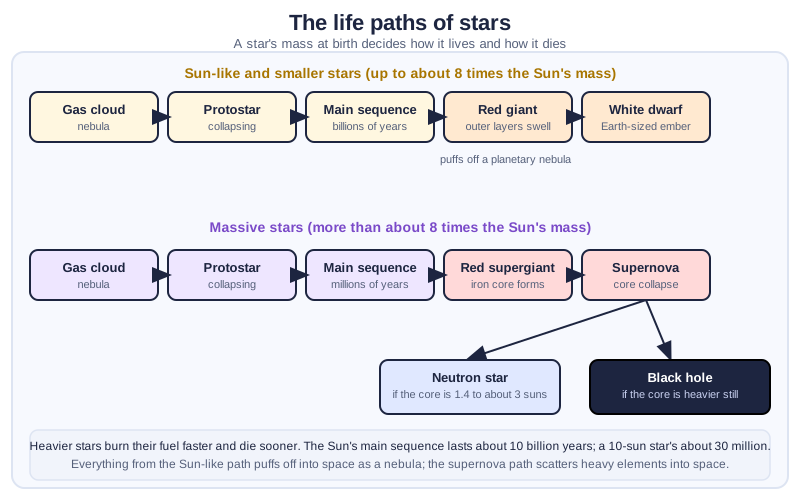
- Hydrogen in the core runs out. The core, now mostly helium, shrinks and heats, while hydrogen fusion continues in a shell around it. The outer layers expand and cool: the star becomes a red giant (Arcturus is one). In the Sun's case (in about 5 billion years, by the standard model) the Sun will swell to more than 100 times its present radius and will likely swallow Mercury and Venus; Earth would be scorched.
- Helium fusion. When the core reaches about 100 million kelvins, helium nuclei fuse into carbon and oxygen (the "triple-alpha" process).
- The star sheds its outer layers. The outer layers drift away to form a glowing shell of gas called a planetary nebula (a bad name, since it has nothing to do with planets).
- A white dwarf remains. The hot dead core, about the size of Earth but with about half the Sun's mass, is a white dwarf. A teaspoon of it would weigh several tonnes. It shines only by stored heat and cools for a very long time. Sirius B is one.

The Chandrasekhar limit: in 1930, the 19-year-old Indian physicist Subrahmanyan Chandrasekhar worked out on a ship to England that a white dwarf cannot be heavier than about 1.4 Suns. Above that, the pressure that holds it up fails.
A Very Massive Star
A star with more than about 8 Suns goes much further:
- It fuses helium, then carbon, then neon, oxygen, silicon, building up a core like an onion with layers of different elements.
- Silicon fusion makes iron. Iron fusion does not release energy; it uses it. The star has hit a dead end.
- In less than a second the iron core, about as big as Earth, collapses to a ball just 20 km across.
- The outer layers rebound off the collapsed core, and the star explodes as a supernova. For a few weeks it can shine as brightly as an entire galaxy of 100 billion stars.

Famous Supernovae
| Supernova | Date | Notes |
|---|---|---|
| SN 1054 | 1054 | Chinese astronomers saw a "guest star" for weeks, even in daylight; it left the Crab Nebula |
| SN 1572 (Tycho's) | 1572 | Brahe showed it was far beyond the Moon (Topic 3.4) |
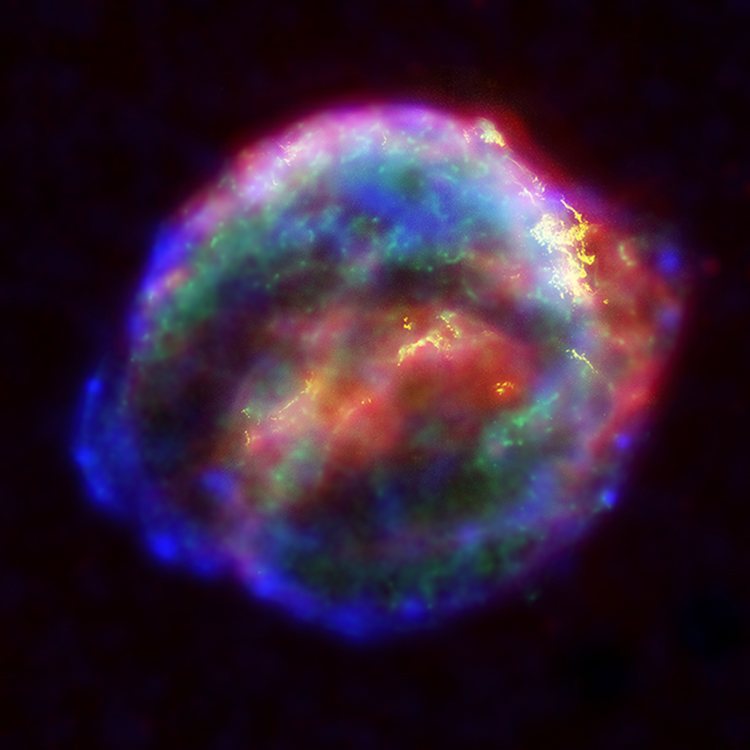
| SN 1604 (Kepler's) | 1604 | the last supernova seen in our own galaxy; Kepler studied it |
| SN 1987A | 1987 | in the Large Magellanic Cloud; neutrinos were detected before the light |
A Second Kind of Supernova
A white dwarf in a binary system can pull gas off its companion. If it grows to the 1.4 Sun limit, it blows up in a Type Ia supernova. These all explode with nearly the same brightness, which makes them "standard candles" for measuring the distance to faraway galaxies (Topic 7.1).
(A note on timelines: the lifetimes and ages in this lesson come from the standard model of how stars work, which is tested by physics we can measure today. Many Christians who study science accept those ages; others, including creation scientists, hold to a much younger universe. How a star shines, how bright it is and how hot it is do not depend on that debate. We give the numbers because they appear in textbooks and tests, and so you can recognize them when you meet them.)
Worth a Pause
The psalmist wrote, "Of old hast thou laid the foundation of the earth: and the heavens are the work of thy hands. They shall perish, but thou shalt endure: yea, all of them shall wax old like a garment; as a vesture shalt thou change them, and they shall be changed" (Psalm 102:25-26). He had never heard of a red giant or a white dwarf. But a person who has watched a star "wax old" in a telescope can read that verse with new eyes: the heavens do change, and the One who made them does not.
Try It: Star Life Cycle. Put a star's life stages in order, decide what a star of a given mass leaves behind, and trace where elements were made. Play Star Life Cycle »
Practice Problems
- What happens in a Sun-like star when the hydrogen in its core runs out?
- What is a planetary nebula, and is it related to planets?
- What is a white dwarf, and what is the Chandrasekhar limit?
- Why does a massive star's core stop being able to produce energy at iron?
- Describe what happens in the few seconds of a core-collapse supernova.
- What was the Crab Nebula's origin, and who recorded it?
- What causes a Type Ia supernova, and why is it useful to astronomers?