Topic 7.3: Hubble's Law: An Expanding Universe
In 1929 Edwin Hubble put together two sets of measurements: the speeds of galaxies, from their redshifts (mostly Slipher's), and their distances, from Cepheids and other methods (Topic 7.1). He graphed one against the other, and found a striking pattern.
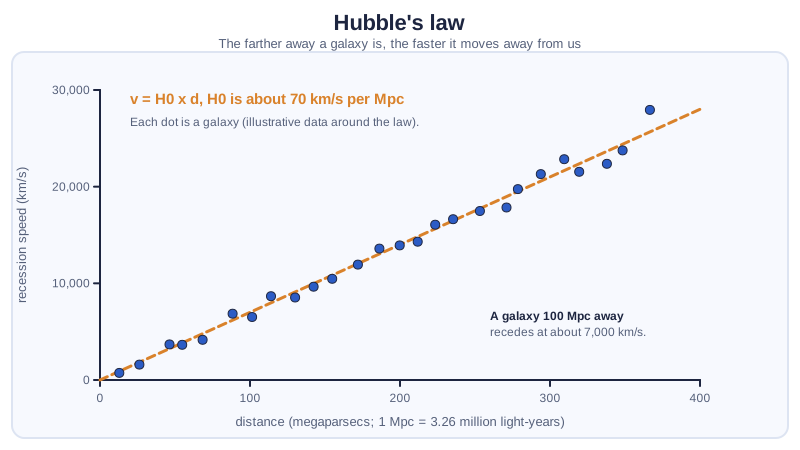
Hubble's Law
The farther away a galaxy is, the faster it is moving away from us.
v = H₀ x d
- v is the galaxy's recession speed (km/s).
- d is its distance (usually in megaparsecs, Mpc; 1 Mpc = 3.26 million light-years).
- H₀ is the Hubble constant, about 70 km/s per megaparsec.
Examples (H₀ = 70):
| Distance | Recession speed |
|---|---|
| 10 Mpc (33 million ly) | 700 km/s |
| 100 Mpc (326 million ly) | 7,000 km/s |
| 1,000 Mpc (3.3 billion ly) | 70,000 km/s |
A galaxy moving away at 14,000 km/s is at d = 14,000 / 70 = 200 Mpc, about 650 million light-years. That is how redshift becomes a distance measurement, the top rung of the ladder.
Not Quite Hubble's Alone
Hubble's first value was about 500 km/s per Mpc, about seven times too large, because his distances were off (there are two kinds of Cepheids, which no one knew yet). The Belgian priest and physicist Georges Lemaitre had published the same relationship in 1927, with a derivation from Einstein's equations, but in a French journal that few read. In 2018 the International Astronomical Union voted to call it the Hubble-Lemaitre law.
What Does It Mean?
Imagine dots drawn on a balloon. As you blow it up, every dot moves away from every other dot, and the farther apart two dots are, the faster they separate. No dot is the center. It is space itself that is stretching, and the galaxies are carried along.
- No center. From every galaxy, the others seem to move away. We are not at the center.
- Galaxies are not flying through space (mostly). Space between them grows.
- Light stretches as space expands, which is why far galaxies are redshifted (the cosmological redshift of Topic 7.2).
- Things held together by gravity do not expand: atoms, people, planets, the solar system, the Milky Way, and the Local Group stay the same size.
Running the Film Backward
If every distance is growing, then in the past they were smaller. Run the expansion backward and the galaxies get closer and closer together. This is the starting point of the Big Bang theory (Topic 7.4).
A rough age comes from 1 / H₀. With H₀ = 70 km/s per Mpc, 1 / H₀ = 14 billion years. A careful analysis that includes the changing rate of expansion gives 13.8 billion years by the standard model.
The Hubble Constant Is Still Debated
Different methods give slightly different values: about 67 km/s per Mpc from the cosmic microwave background (Topic 7.4), and about 73 from the distance ladder. The gap is called the Hubble tension. It may be a small error somewhere, or a sign that something is missing in the standard model. This is a current research question.
(A note on timelines: the ages and dates in this lesson, such as 13.8 billion years since the Big Bang, come from the standard model of cosmology, which fits a great many observations. Many Christians who study science accept that timeline; others, including creation scientists, hold to a much younger universe and have their own proposals about distant starlight. We tell you what the standard model says, and what it rests on, so that you can recognize it in books and tests and weigh it for yourself. Topic 7.7 sets out the different readings side by side.)
Worth a Pause
Several times the prophets speak of God as the One who "stretcheth out the heavens." Isaiah writes, "Thus saith God the LORD, he that created the heavens, and stretched them out" (Isaiah 42:5). The prophets used the image because they saw the sky as a great tent-curtain drawn across the earth. In the twentieth century astronomers found, in their own way, that the heavens are indeed being stretched. We do not need the verse to prove the telescope or the telescope to prove the verse; it is enough to notice how well the old image fits.

Try It: Expansion Lab. Use Hubble's law to turn distance into speed, find redshift, and estimate the Hubble time. Play Expansion Lab »
Practice Problems
- State Hubble's law in words and in an equation.
- Using H₀ = 70 km/s per Mpc, how fast is a galaxy 50 Mpc away receding?
- A galaxy is receding at 21,000 km/s. How far away is it?
- Why does the balloon model show that there is no center of the expansion?
- Do the Milky Way and the solar system expand with the universe? Why not?
- What does it mean that Georges Lemaitre's name was added to the law in 2018?
- What is the Hubble tension?