Topic 7.5: Dark Matter and Dark Energy
Everything we have seen so far, stars, gas, planets, people, makes up only about 5% of the universe, according to the standard model. The rest is dark.

Dark Matter
What it is: matter that gives off no light but has gravity. It makes up about 27% of the universe.
The clues:
- Galaxy clusters (1933). Fritz Zwicky found that the galaxies in the Coma Cluster moved too fast for the visible mass to hold them (Topic 6.5).
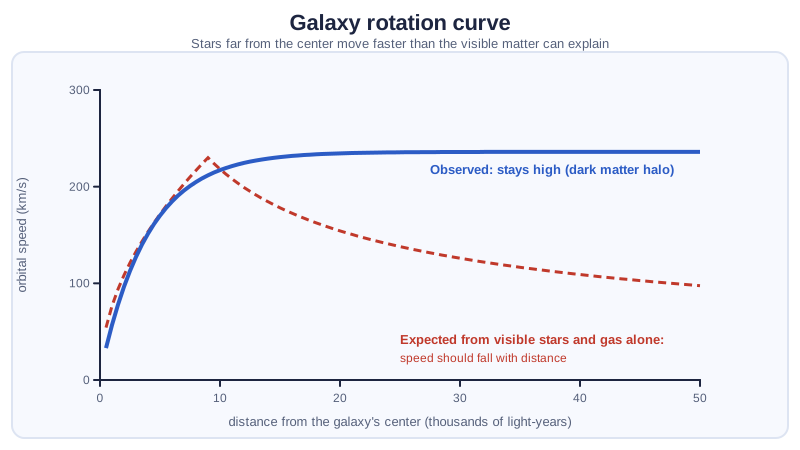
- Rotation curves (1970s). Vera Rubin and Kent Ford measured the speeds of stars and gas at different distances from the centers of spiral galaxies. If the mass were in the stars, outer stars should move more slowly (like the outer planets). Instead the speeds stay about the same, so there is a lot of extra mass, spread out in a huge halo.
- Gravitational lensing. Clusters bend light more than their visible matter can (Topic 6.5).
- The Bullet Cluster (2006). Two galaxy clusters collided. The hot gas (the main ordinary matter) was slowed and stayed in the middle, but the lensing showed that most of the mass passed through, just where the galaxies are. Mass and ordinary matter had separated.
- The CMB. The sizes of the ripples depend on how much dark matter there was (Topic 7.4).

What is it? Nobody knows. Experiments in deep mines and in space have looked for the leading candidates, such as WIMPs (weakly interacting massive particles) and axions, and so far have not found them. A few astronomers suggest that gravity itself works differently at very low accelerations (a theory called MOND), but it has trouble with the Bullet Cluster and the CMB.
Dark Energy
What it is: a mysterious "something" that makes the expansion of the universe speed up. It makes up about 68%.
The discovery (1998). Two teams were measuring distances using Type Ia supernovae (Topic 7.1), hoping to measure how much the expansion was slowing down because of gravity. Instead they found that the faraway supernovae were fainter than expected: the expansion has been speeding up. Saul Perlmutter, Brian Schmidt and Adam Riess shared the 2011 Nobel Prize.
The simplest explanation is a constant energy of empty space, the cosmological constant (Λ), a term Einstein once added to his equations and later dropped. Another possibility is something that changes with time. Recent surveys (DESI) have hinted that it may be changing, but the evidence is not yet strong enough to say.
An Honest Summary
| Part of the universe | Share | What we know |
|---|---|---|
| Ordinary matter | about 5% | stars, gas, planets, us |
| Dark matter | about 27% | its gravity, not what it is |
| Dark energy | about 68% | the speeding-up, not what it is |
So astronomers have a successful model that fits many measurements, and that says that 95% of the universe is made of things we do not understand. That is not a failure; it is how research works, and it is also a lesson in humility. Some day the story may change, as it did with the Sun-centered system, or with Mercury's orbit before Einstein.
(A note on timelines: the ages and dates in this lesson, such as 13.8 billion years since the Big Bang, come from the standard model of cosmology, which fits a great many observations. Many Christians who study science accept that timeline; others, including creation scientists, hold to a much younger universe and have their own proposals about distant starlight. We tell you what the standard model says, and what it rests on, so that you can recognize it in books and tests and weigh it for yourself. Topic 7.7 sets out the different readings side by side.)
Worth a Pause
Job said of God, "He stretcheth out the north over the empty place, and hangeth the earth upon nothing" (Job 26:7). "Nothing" turns out to be a very interesting word in physics: empty space may hold an energy that drives the whole universe apart. It would be foolish to read a modern theory into a verse that old, and equally foolish to be so sure of our own that we stop wondering. The right posture before the dark is the one Job learned at the end of his book: to say, "I have uttered that I understood not; things too wonderful for me, which I knew not" (Job 42:3).
Try It: Big Bang Evidence. Match evidence to claims, order the standard timeline, and sort what is measured from what is inferred. Play Big Bang Evidence »
Practice Problems
- Roughly what share of the universe is ordinary matter, dark matter and dark energy?
- What did Zwicky find in the Coma Cluster in 1933?
- What did Vera Rubin find about the speeds of stars in spiral galaxies?
- What did the Bullet Cluster show?
- How was dark energy discovered in 1998?
- Name one candidate for dark matter that scientists have searched for.
- In what sense is it right to say that 'we do not know what 95% of the universe is made of'?