Topic 8.7: Exoplanets
For centuries people wondered whether other stars have planets. The answer, which came in the 1990s, is yes, very many. NASA's catalog now lists more than 6,000 confirmed exoplanets (planets outside the solar system), with thousands more candidates, and it seems that most stars have planets.
How to Find a Planet You Cannot See
A planet is tiny and faint next to its star, like finding a firefly next to a searchlight from a mile away. So astronomers mostly look for the planet's effect on its star.
1. The Transit Method

When a planet crosses in front of its star, it blocks a little light. The star seems to dim briefly, then recover. This is a transit.
- The size of the dip tells the planet's size: depth = (planet radius / star radius) squared. For Jupiter crossing the Sun, depth = (0.1)² = 1%. For Earth, (0.009)² = 0.008%.
- The time between dips gives the orbital period.
- NASA's Kepler Space Telescope (2009-2018) stared at 150,000 stars in one patch of sky and found about 2,700 confirmed planets. TESS (launched 2018) is surveying the whole sky.
2. The Radial-Velocity (Wobble) Method
A planet's gravity makes its star wobble, and we see the wobble as a tiny Doppler shift (Topic 7.2). In 1995, Michel Mayor and Didier Queloz found the first planet around a Sun-like star, 51 Pegasi b, this way. (The first exoplanets of all, around a pulsar, were found in 1992.) Jupiter makes the Sun move at 12 m/s; Earth only 9 cm/s.
3. Other Methods
- Direct imaging: blocking the starlight to photograph young, big, far-out planets.
- Microlensing: a planet bends the light of a more distant star as it passes in front (Topic 3.7).
What We Have Found
- Hot Jupiters: huge planets orbiting in just a few days, hotter than a furnace. We did not expect those.
- Super-Earths and mini-Neptunes: planets between Earth and Neptune in size. There are none in our solar system, yet they appear to be the most common kind.
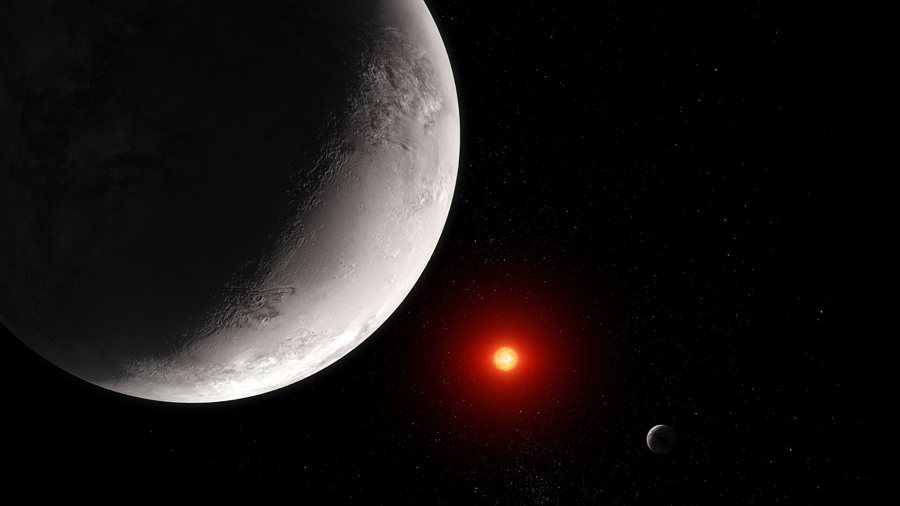
- Planets around red dwarfs: TRAPPIST-1, 40 light-years away, has seven rocky planets about the size of Earth, several in the habitable zone.
- Planets orbiting two stars, like Tatooine; planets with no star at all.
The Habitable Zone

The habitable zone is the range of distances where a planet could have liquid water on its surface. For the Sun it is roughly 0.95 to 1.4 AU: Earth is in it, Venus is too close, Mars is at the edge. Red dwarfs are dimmer, so their zones are closer in.
Being in the zone is not the same as being habitable. A planet also needs the right mass, atmosphere and magnetic field. Venus sits near the inner edge and is a furnace.

Reading Their Air
The James Webb Space Telescope looks at starlight that passes through a planet's atmosphere during a transit (Topic 5.4). It has found water vapor, carbon dioxide, sulfur dioxide and more on gas giants, and is beginning to study smaller worlds.
Worth a Pause
The psalmist said of the heavens, "By the word of the LORD were the heavens made; and all the host of them by the breath of his mouth" (Psalm 33:6). It turns out that the "host" includes at least as many planets as stars. We did not know that a generation ago. It is wise to stay modest about what we may yet find, and also to remember that a Creator who made so much does not need our permission to be generous.
Try It: Transit Hunter. Read light curves, size planets from the dip, and find each star's habitable zone. Play Transit Hunter »
Practice Problems
- What is an exoplanet?
- Explain the transit method of finding planets.
- A planet crossing a star blocks 1% of its light. What is the ratio of the planet's radius to the star's radius?
- How was the first planet around a Sun-like star found?
- What are super-Earths and why are they surprising?
- What is the habitable zone?
- Why is a planet in the habitable zone not necessarily habitable?