Topic 2.3: Sunlight, Axial Tilt and Zenith Angle
In the last lesson we said that a high Sun gives more concentrated sunlight. Now let's put numbers on it. This is the standard's math: zenith angle, solar angle and surface area.
Two Angles for the Same Thing
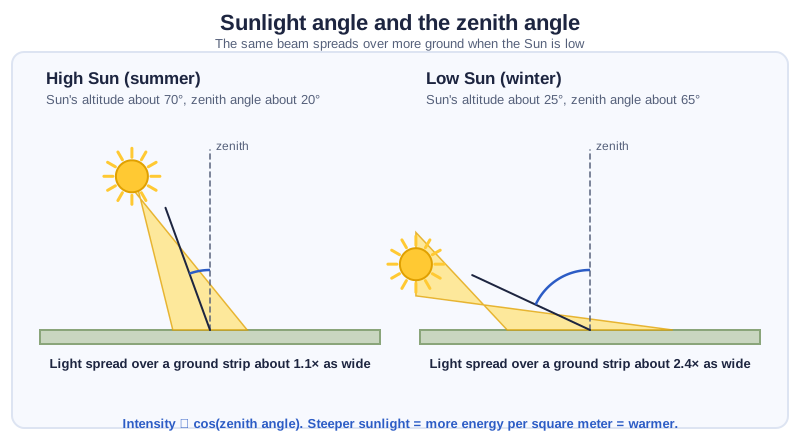
- Solar altitude (or solar elevation), a: the Sun's angle above the horizon.
- Zenith angle, z: the Sun's angle measured from straight overhead.
They always add up to 90 degrees:
z = 90 degrees - a
At noon on a day when the Sun is straight overhead, a = 90 degrees and z = 0.
Why a Low Sun Is Weaker
Picture a beam of sunlight with a fixed width, like the beam of a flashlight. When the Sun is directly overhead, the beam lands on a patch of ground that is the same size as the beam. When the Sun is low, the same beam is spread over a longer, thinner stretch of ground. The same energy now covers more area, so each square meter gets less.
If the beam hits the ground at solar altitude a, it spreads over an area bigger by a factor of 1 / sin(a). The energy per square meter is then
intensity = (solar constant) x sin(a) = (solar constant) x cos(z)
At the top of the atmosphere the solar constant is about 1,361 watts per square meter. (Air, clouds and haze take away more, especially when the Sun is low and its light crosses more air.)
The Sun's Height at Noon
On any day, the Sun is highest at solar noon. At that moment:
a = 90 degrees - |latitude - declination of the Sun|
The Sun's declination (the latitude where it is straight overhead) is about +23.5 degrees at the June solstice, 0 degrees at the equinoxes, and -23.5 degrees at the December solstice.
Worked example: Montgomery, Alabama (latitude about 32.4 degrees north)
| Date | Declination | Noon altitude a | Zenith angle z | sin(a) |
|---|---|---|---|---|
| June solstice | +23.5 | 90 - (32.4 - 23.5) = 81.1 degrees | 8.9 degrees | 0.988 |
| Equinox | 0 | 90 - 32.4 = 57.6 degrees | 32.4 degrees | 0.844 |
| December solstice | -23.5 | 90 - (32.4 + 23.5) = 34.1 degrees | 55.9 degrees | 0.561 |
So at noon in June, Alabama gets about 1.76 times (0.988 / 0.561) more sunlight per square meter than at noon in December. Add the longer June day, and the total energy gap between summer and winter is even bigger.
Notice that the shadow of a 1-meter stick at noon is tan(z) meters long: only 0.16 m in June, but 1.5 m in December.
Tilt and the Tropics
At the Tropic of Cancer (23.5 N) the Sun is straight overhead once a year, at the June solstice. Between the two tropics (the tropics), the Sun gets directly overhead at least once. North of 23.5 degrees, as in Alabama, it never is.
Worth a Pause
A farmer in Alabama does not need a degree in trigonometry to know that June is hot and December is cold, but there is something satisfying in being able to put a number on it. The same sine function that tells us how a ramp feels also tells us how the Sun's rays land. Nature is not only beautiful to look at. It can be calculated, and it keeps the same rules every day. "Great are the works of the LORD, sought out of all them that have pleasure therein" (Psalm 111:2).
Try It: Season Switch. Tilt Earth around its orbit and predict the season, day length and Sun height in Alabama. Play Season Switch »
Practice Problems
- What is the relationship between a star's altitude and its zenith angle?
- If the Sun is at altitude 30 degrees, what is its zenith angle?
- Explain why a low Sun delivers less energy per square meter than a high Sun.
- At the December solstice (declination -23.5), find the Sun's noon altitude in Birmingham, at latitude 33.5 degrees north.
- For the same city at the June solstice (declination +23.5), find the noon altitude.
- Using sin(a), compare the two intensities from questions 4 and 5. By what factor is June stronger?
- Why does the Sun never get straight overhead in Alabama?