Topic 2.4: The Moon: Features and Origins
The Moon is the second brightest thing in our sky and the only place beyond Earth where human beings have walked. It is also a simple world to study, because there is no weather to change it. Footprints left there in 1969 are still there.
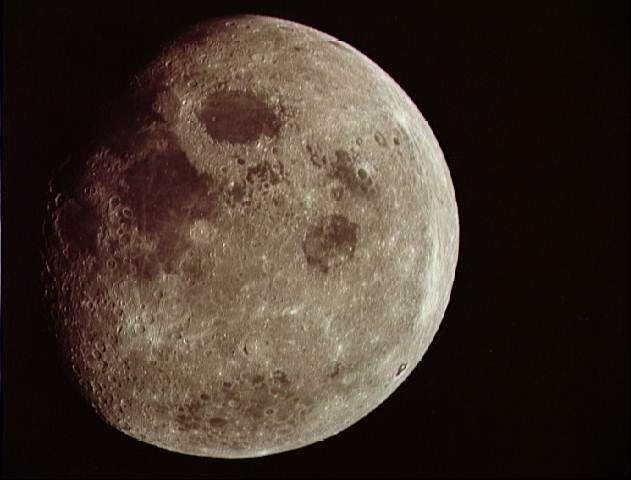
Quick Facts
| The Moon | |
|---|---|
| Distance from Earth | about 384,400 km (30 Earth-widths away) |
| Diameter | 3,474 km, about 1/4 of Earth's |
| Gravity | about 1/6 of Earth's (a 60 kg person weighs about 10 kg-force) |
| Atmosphere | essentially none |
| Temperature | about -173 C at night to +127 C by day |
| Orbit | 27.3 days around Earth, relative to the stars |
What You See on the Moon
- Maria (Latin for "seas," singular mare): large, dark, smooth plains. They are not water. They are old lava flows of dark volcanic rock (basalt) that filled huge impact basins.
- Highlands: the bright, rough, heavily cratered regions. They are made of lighter rock.
- Craters: bowls made by impacts of rocks from space. With no air or water to erode them, craters can last for billions of years (by the standard timeline).
- Regolith: a layer of powdery crushed rock covering the surface.
One Face Always Toward Us
The Moon rotates exactly once for every orbit, so the same side always faces Earth. This is called tidal locking. Earth's gravity gently stretched the Moon and slowed its spin until the two matched. The "far side" is not "dark." It gets just as much sunlight as the near side. It was first photographed in 1959 by the Soviet probe Luna 3.

Humans on the Moon
Between 1969 and 1972, NASA's Apollo program landed 12 astronauts on the Moon in six missions. They brought back 382 kg of rock and soil. The rockets that took them there, the Saturn V, were designed and tested at the Marshall Space Flight Center in Huntsville, Alabama. We return to that story in Unit 8.
Where Did the Moon Come From?
Scientists have proposed several ideas. The one most widely accepted today is the giant impact hypothesis: early in the solar system's history, a Mars-sized body (nicknamed Theia) struck the young Earth. The debris from the collision formed a ring, and the ring gathered into the Moon. Evidence for the idea includes:
- Moon rocks have an oxygen composition almost identical to Earth's, and unlike meteorites.
- The Moon's density is lower than Earth's and its iron core is small, like Earth's outer layers.
- Computer models of such an impact can make a Moon like ours.
There are still open puzzles, such as why the Moon's rocks are so very much like Earth's. Scientists keep testing.
(A note on timelines: the ages scientists give for the Moon and the solar system, billions of years, come from radiometric dating and the standard model of solar system formation. Many Christians who study science accept those ages; others, including creation scientists, hold to a much younger earth. We mention the numbers because they appear in textbooks and tests, and so you can recognize them when you meet them.)
Worth a Pause
The Moon was made, we read, to be a "lesser light to rule the night" (Genesis 1:16). It lights the dark, it pulls the tides, it gives us a month, and it also gave a few men a place to stand and look back at Earth. One of the Apollo 8 astronauts, orbiting the Moon at Christmas in 1968, read from Genesis to a world listening below. The sight of that small blue marble hanging over a gray, dead horizon has moved many people to wonder about the Maker. Some videos on this page say the Moon formed from a giant impact billions of years ago. That is a theory, and it is worth saying so out loud. Ask the question the textbook leaves out: whatever the method, who made the Moon, and why is it just the right size and distance to give us tides, phases and eclipses?

Try It: Moon Phase Match. Match each spot in the Moon's orbit to the phase you would see from Earth, then call the tides. Play Moon Phase Match »
Practice Problems
- What are the Moon's maria, and what are they made of?
- Why do we always see the same side of the Moon?
- About how strong is the Moon's gravity compared with Earth's?
- Why do footprints and craters last so long on the Moon?
- Describe the giant impact hypothesis for the Moon's origin.
- Give two pieces of evidence for the giant impact hypothesis.
- How many people have walked on the Moon, and in which program?