Topic 2.5: Phases of the Moon
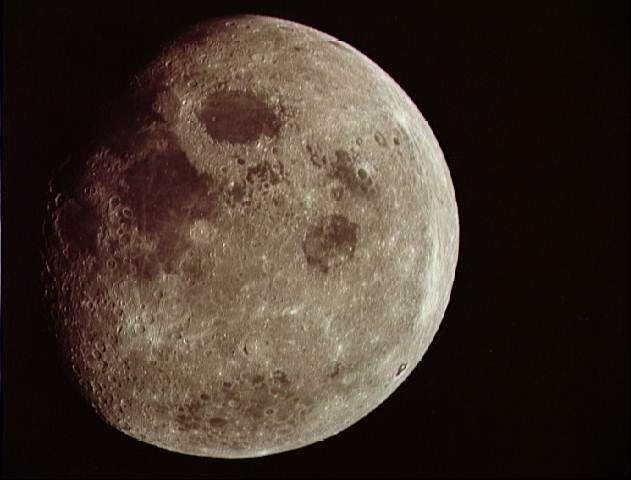
Over about a month, the Moon seems to grow from a thin sliver to a full circle and shrink back again. The Moon is not changing. What we see is the changing view of the half of the Moon that is lit by the Sun.
The Key Idea
The Sun always lights half of the Moon (the half facing the Sun), just as it lights half of Earth. As the Moon orbits Earth, we see more or less of that lit half.
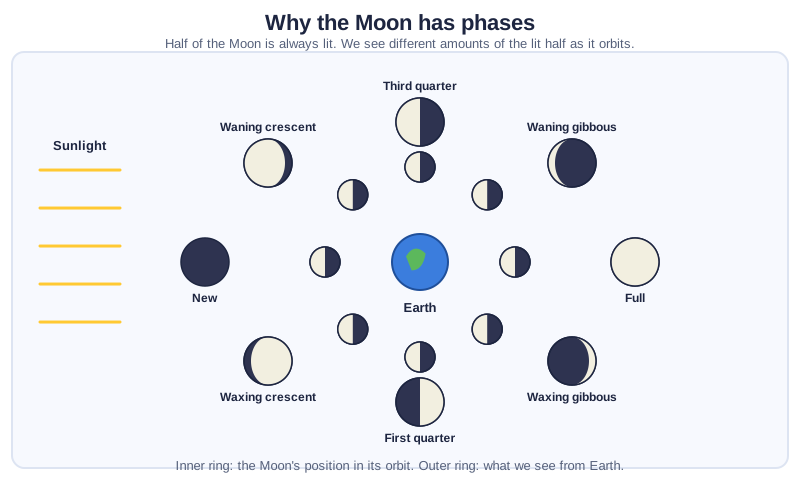
The Eight Phases
| Phase | Where the Moon is | What we see |
|---|---|---|
| New Moon | Between Earth and Sun | The lit half faces away from us: dark |
| Waxing crescent | Starting to move around | A thin sliver, on the right side |
| First quarter | A quarter of the way around | Right half lit |
| Waxing gibbous | More than half lit | |
| Full Moon | Opposite the Sun | The whole face lit |
| Waning gibbous | Shrinking from the right | |
| Third (last) quarter | Left half lit | |
| Waning crescent | A thin sliver on the left |
Waxing means growing and waning means shrinking. Crescent means less than half lit, gibbous more than half. (These descriptions are for the Northern Hemisphere. Everything is mirrored in the south.)
A full cycle, new Moon to new Moon, takes 29.5 days (a synodic month). That is a bit longer than the 27.3 days it takes the Moon to circle Earth relative to the stars, because Earth has moved along its own orbit in the meantime.
When Does the Moon Rise?
Each phase has a typical schedule, because the Moon's position relative to the Sun sets it:
| Phase | Rises about | Sets about |
|---|---|---|
| New | sunrise | sunset |
| First quarter | noon | midnight |
| Full | sunset | sunrise |
| Third quarter | midnight | noon |
A half-lit Moon in the afternoon sky is a first quarter Moon, so the Moon is not just a night object.
Common Mistake: It Is Not Earth's Shadow
Many people think phases come from Earth's shadow covering part of the Moon. They do not. Earth's shadow only falls on the Moon during a lunar eclipse, which is rare. Phases happen every month.
The Moon and the Calendar
The word month is from Moon. Many calendars, like the Jewish and Islamic calendars, are based on lunar months, and Easter is still set by the Moon: it falls on the first Sunday after the first full Moon of spring.
Worth a Pause
The psalmist praised the Moon for keeping time: "He appointed the moon for seasons: the sun knoweth his going down" (Psalm 104:19). The fact that the Moon's cycle is so regular made it humanity's second calendar after the day. When you see a thin crescent in the evening, you are seeing the start of a month, with the whole cycle still ahead.

Try It: Moon Phase Match. Match each spot in the Moon's orbit to the phase you would see from Earth, then call the tides. Play Moon Phase Match »
Practice Problems
- Why does the Moon have phases?
- How many days from one new Moon to the next?
- What do waxing and waning mean?
- At about what time does a full Moon rise?
- A half-lit Moon on the right side is visible at sunset. Which phase is it? Does it wax or wane afterwards?
- Explain why Earth's shadow is not the cause of phases.
- Why is a month of Moon phases (29.5 days) longer than the Moon's orbit around Earth (27.3 days)?