Topic 4.9: Gravity, Newton and Orbits
In Topic 3.6 we met Newton's idea that gravity holds the Moon in orbit. This lesson puts numbers on it.
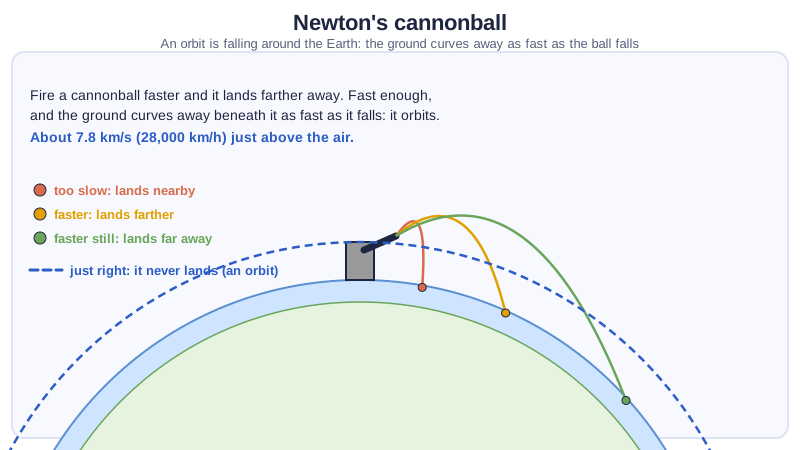
An Orbit Is Falling Sideways
A satellite in orbit is falling, but it is also moving sideways so fast that the ground curves away beneath it as quickly as it falls. It misses the Earth, over and over.
- Gravity is the pull. It points toward the center of the planet.
- Speed is the sideways motion. It must be fast enough.
If the speed is too low, the satellite spirals down. If it is too high, the orbit stretches out into a long ellipse, and at one critical speed it escapes completely.
How Fast Must You Go?
| Orbit | Height | Speed | Period |
|---|---|---|---|
| International Space Station | about 400 km | 7.7 km/s (27,600 km/h) | 92 minutes |
| GPS satellites | 20,200 km | 3.9 km/s | 12 hours |
| Geostationary | 35,786 km | 3.1 km/s | 24 hours |
| The Moon | 384,400 km | 1.0 km/s | 27.3 days |
The higher the orbit, the slower the speed and the longer the period. That's Kepler's third law again, now explained by gravity.
- The ISS circles the Earth about 16 times a day, with astronauts seeing 16 sunrises.
- A geostationary satellite takes 24 hours, the same as Earth's spin, so it hangs over one spot. Weather and TV satellites use this.
Why Do Astronauts Float?
Not because there is no gravity. At the ISS's height, gravity is still about 89% as strong as on the ground. The astronauts and the station are falling together, so nothing pushes them against the floor. This is called free fall, or microgravity. It feels like weightlessness, but it is really a state of continuous falling.
Escape Velocity
To leave Earth for good, you need escape velocity: about 11.2 km/s (40,300 km/h) from the surface. Each body has its own:
| Body | Escape velocity |
|---|---|
| Moon | 2.4 km/s |
| Earth | 11.2 km/s |
| Jupiter | 59.5 km/s |
| Sun (at its surface) | 618 km/s |
That is also why the Moon has no air to speak of: its gravity is too weak to hold most gases.
Weight on Other Worlds
Mass (how much matter you have) stays the same everywhere. Weight (the pull of gravity on you) changes. A person who weighs 100 pounds on Earth weighs about 17 pounds on the Moon, 38 on Mars, and about 250 at the top of Jupiter's clouds.
Gravity Assist
Spacecraft can steal a little speed from a planet. When a probe passes close behind a moving planet, the planet's gravity slings it forward. The Voyager probes used Jupiter and Saturn this way to reach the outer solar system, with only a small amount of fuel.
Alabama Connection
At the Marshall Space Flight Center in Huntsville, engineers designed the Saturn V rocket that sent Apollo astronauts to the Moon, and its first stage and engines were tested there. The town still helps build NASA's rockets today. (We tell the story of the man who led that team, honestly and in full, in Topic 8.4.)
Worth a Pause
Newton showed that the rule that pulls an apple is the same rule that holds the Moon. Jeremiah speaks of the "ordinances of heaven and earth" (Jeremiah 33:25), one set of rules for both. A law that works on a kitchen table and in the rings of Saturn is like finding that a whole continent uses the same alphabet.

Try It: Orbit Lab. Launch a satellite, tune its speed, and see whether it falls, orbits or escapes. Play Orbit Lab »
Practice Problems
- Describe an orbit in your own words using the words 'fall' and 'sideways'.
- What happens to orbital speed and period as the height of an orbit increases?
- Why do astronauts on the ISS float?
- What is escape velocity from Earth's surface?
- Why is a geostationary satellite useful?
- What does a person who weighs 100 pounds on Earth weigh on the Moon?
- What is a gravity assist?