Topic 5.4: Spectra: What Stars Are Made Of
We can never visit a star, yet we know what the Sun is made of, and what a star a thousand trillion miles away is made of. The trick is the spectrum: light spread out by a prism or a grating into its colors, like a rainbow.
Three Kinds of Spectra
In the 1850s the German physicist Gustav Kirchhoff described three simple rules:

- A hot, dense object (a light bulb filament, the surface of a star) gives off a continuous spectrum, a smooth rainbow.
- A hot, thin gas gives off emission lines: bright lines at certain colors only.
- A cool gas in front of a continuous source takes away exactly those same colors, leaving dark absorption lines in the rainbow.
Each element has its own pattern of lines, a kind of fingerprint. Hydrogen has four visible lines (the Balmer series: red H-alpha at 656.3 nm, and others at 486.1, 434.0 and 410.2 nm). Sodium has a bright yellow pair, which is why street lamps used to glow that color. Helium, iron, calcium, and every other element have their own set.
The Sun's Spectrum
In 1814 Joseph von Fraunhofer, a German lens-maker, looked at sunlight through a prism and found hundreds of dark lines. Today we know that they are the absorption lines of the elements in the Sun's cooler outer layers. In 1868 astronomers saw an unknown yellow line in the Sun's spectrum during an eclipse; they named the element helium (from helios, Greek for Sun). It was not found on Earth until 1895.
Spectral Classes
Annie Jump Cannon sorted stars by the lines in their spectra into the classes O, B, A, F, G, K, M (Topic 3.8). But why do the lines vary? At first astronomers thought stars were made of different mixes of elements. In 1925, Cecilia Payne showed that the difference is temperature, not composition: nearly all stars are about 75% hydrogen and 25% helium by mass. The hydrogen lines are strongest at about 10,000 K (class A); in a very hot star the hydrogen is mostly ionized (stripped of its electron), and in a cool star it is not excited enough to absorb visible light.
| Class | Temperature | Strongest lines | Example |
|---|---|---|---|
| O | above 30,000 K | ionized helium | Mintaka |
| B | 10,000 to 30,000 K | neutral helium | Rigel |
| A | 7,500 to 10,000 K | hydrogen | Sirius, Vega |
| F | 6,000 to 7,500 K | ionized metals | Procyon |
| G | 5,200 to 6,000 K | ionized calcium | The Sun |
| K | 3,700 to 5,200 K | neutral metals | Arcturus |
| M | 2,400 to 3,700 K | molecules such as titanium oxide | Betelgeuse |
More From Spectra
- Speed: If a star moves toward us or away from us, its lines shift to the blue or the red (the Doppler effect, Topic 7.2).
- Spin: a fast-spinning star has smeared lines.
- Planets: the light from a star shining through an exoplanet's atmosphere carries the planet's fingerprints too. The James Webb Space Telescope has found water vapor, carbon dioxide, and other gases around other worlds this way.
- Magnetic fields: strong fields split lines into pieces.
Worth a Pause
The psalmist says of God, "He telleth the number of the stars; he calleth them all by their names" (Psalm 147:4). Astronomers have a small echo of that. Every star has its own spectral fingerprint, and a trained eye can tell one star from another by it, as you might know a friend's handwriting. We have not named each star as He has, but we can read each one's signature, and that is no small thing.
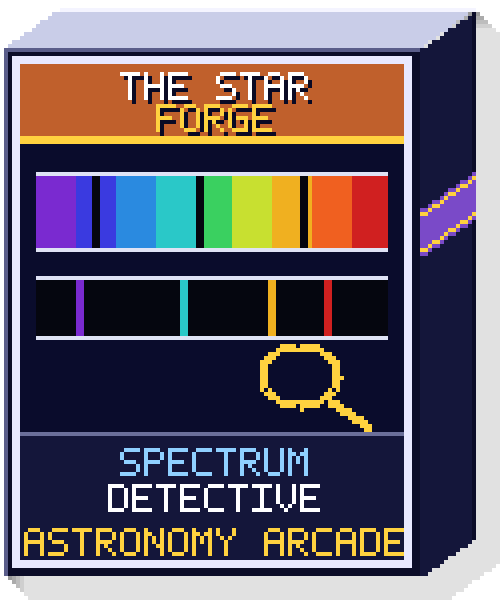
Try It: Spectrum Detective. Tell rainbows from bright and dark lines, match an element's fingerprint, and read a star's color. Play Spectrum Detective »
Practice Problems
- What kind of spectrum does a hot, dense object give off?
- How do absorption lines form in a star's spectrum?
- Why does each element have its own pattern of lines?
- How did astronomers discover helium?
- What did Cecilia Payne show about the differences between stars' spectra?
- What is the spectral class of the Sun, and what is its surface temperature?
- Name two other things a star's spectrum can tell us, besides what it is made of.